

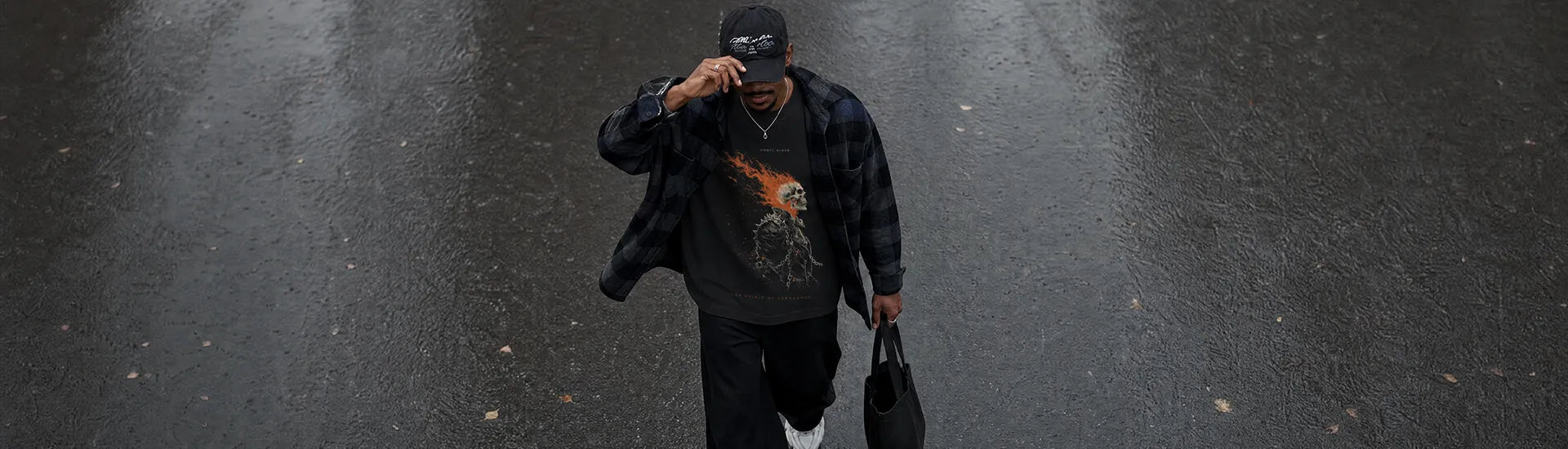
The Graphic Tees Buying Guide for People Who Already Know What They Like
The best version of a graphic tee is a very specific object. It carries a specific piece of information about the person wearing it. Not "I like movies" or "I play games," but something closer to: I watched The Thing in a dark room and thought about it for three days. I know what Negan did with Lucille. I was there when the Predator franchise stopped being embarrassing. Graphic tees, when they work, are a shorthand that cuts through everything else.
The bad version is everywhere. Thin white cotton with a character face centered on the chest, printed on whatever blank came out of the cheapest shipper, available in every size always, the same shirt you've seen a hundred times because it costs four dollars to produce and twenty-five to sell. You can spot these immediately. They crack after six washes, they don't actually know the material they're referencing, and they exist because someone typed a franchise name into a print-on-demand tool and clicked confirm.
This guide is for the other kind.
Most graphic tees are bad. Here's why that's actually useful information.
The volume of bad movie merch on the market right now is, in a strange way, a service. It makes the good stuff easier to find because the gap is so obvious. When you pick up a shirt printed on a 6.1oz garment-dyed blank, the weight difference is immediate. When a design captures something specific about the source material — a line of dialogue, a compositional choice, a moment that only people who watched the film would recognise — it reads differently than a character portrait on white cotton.
The problem isn't that bad graphic tees exist. The problem is that they've trained buyers to expect nothing. Most people buying licensed merch have been burned enough times that they've stopped looking for shirts built with any care, which means when something built with care shows up, it doesn't get found.
That's what this guide is for. Not a trend report. Not a list of what's popular on TikTok this week. A framework for finding graphic tees that are actually worth owning, and a specific collection that holds up against that framework.
What makes a movie graphic tee worth keeping
A movie graphic tee is worth keeping when three things are true: the blank won't fall apart, the print won't crack, and the design actually knows the film it's referencing. All three need to be present. Two out of three produces a shirt you'll keep for one season and donate.
The blank question comes down to weight and construction. Garment-dyed, pre-shrunk, heavyweight cotton is the field standard for a shirt you'll own for years. Comfort Colors runs a pigment-dye process that gives the fabric a lived-in character from day one. The colors sit differently than a standard dye job, the hand feel is softer, and the garment doesn't lose its shape after a cycle. A shirt built on that blank doesn't need to be replaced every two years. Which is part of the point.
The design question is harder to reduce to a checklist, but the test is simple: does this shirt capture something specific, or does it put a character on a shirt? The first approach requires actually knowing the film. The second requires a license and a printer. The broader shift in 2026 graphic tee culture is toward artwork that feels emotional and story-based rather than logo-forward. That shift has been true in streetwear for a decade. The good shirts have always known the difference.

The Avengers: Doomsday problem (and why right now is the best time to buy a Doctor Doom shirt)
Avengers: Doomsday hits theaters December 18, 2026. The Russo Brothers are back. Robert Downey Jr. returns as Victor Von Doom. Official merchandise is already circulating: a Spencer's keychain here, an Amazon listing there, a low-res shirt design with inconsistencies in the chest armor that may or may not be AI-generated. The theatrical merch machine is starting to crank.
This is how it always goes. Six months before a major Marvel release, the licensed product wave arrives: thin cotton, centered logo, available everywhere, forgotten immediately. The window to own a Doctor Doom shirt that doesn't look like it came from a cinema gift shop is right now, before the flood.
Doom's MCU design is comic-accurate: iron mask, green cloak, the armor that reads as medieval and technological at the same time. The character has forty years of visual language behind him. A shirt that captures that visual language specifically, rather than slapping a logo on it, is a different object than anything you'll find in December.

Horror and sci-fi movie graphic tees: the ones that actually hold up
The franchises worth putting on a shirt are the ones that survived long enough to mean something. Alien, Predator, The Thing, Terminator. These films are still in cultural circulation not because of nostalgia but because the imagery holds up on its own terms. MacReady in the cold. The Jungle Hunter's mandibles. The T-800 skeleton walking through fire. These are images that work outside their original context, which is exactly what you need a shirt to do.
The Predator franchise is having a specific moment right now. Predator: Killer of Killers (2025), Dan Trachtenberg's second entry in the series after Prey, has brought a new wave of attention back to the original 1987 film, and to the shared DNA between Predator, The Thing, and Terminator as the ur-texts of practical-effects sci-fi action. If you're watching one of them, you're probably rewatching all three.


The Terminator sits in a different register. James Cameron's 1984 film doesn't have the same franchise momentum right now, but the T-800 endoskeleton is one of the most iconic images in sci-fi cinema, and a shirt built around the right visual moment from that film carries weight that a reboot-era design never will. Same with Ripley in Alien. Not Ripley the brand, but Ripley the specific character in a specific film, which is an entirely different thing.

The collection also covers Event Horizon, the Paul W.S. Anderson deep-cut that is still the most unsettling thing ever done with a spaceship, and recent horror like Weapons (2025). For the full range, the Halloween graphic tees collection runs across horror film, horror gaming, and the space between them.
Why the blank matters as much as the graphic
You're going to wear this shirt for years. That's the premise of buying something worth owning. Which means the fabric is not a secondary consideration. It's what you're actually putting on your body every time you reach for it.
The difference between a 4.5oz ring-spun cotton shirt and a 6.1oz garment-dyed heavyweight is not subtle. The lighter shirt is what you get when the seller's margin is the first priority. It goes thin at the collar, it loses its shape, the print starts lifting after a year. The heavier blank has structural weight. It drapes differently, it moves differently, and the garment-dye process means the color is in the fabric rather than on top of it. Which means it ages the way good clothes age, rather than just deteriorating.
Comfort Colors is the blank that streetwear buyers recognise. It's not an accident that the brands making limited-run heavyweight graphic tees with actual design budgets use the same blank. The signal is immediate to anyone who's held one.
Limited drops versus always-available: what you're actually choosing between
The always-available model produces a certain kind of shirt. It's designed to be restocked, which means it's designed for volume, which means it's designed to offend no one. The design is safe because it has to sell across a year of continuous availability. The blank is cheaper because margins at that scale require it. The result is exactly what you'd expect: a shirt that looks like everything else, available whenever you want it, worth approximately what it costs to acquire.
The limited-drop model produces a different object. When a run ends, it ends. The design doesn't need to be safe. It needs to be right. Which means it can go specific, can reference something that only a particular audience recognises, can capture a moment rather than a character. That's not a scarcity tactic. That's the entire design philosophy.
The CR best sellers tell you which designs connected. But the more useful thing to know is which ones are still available. When a design on Cruel Royalty sells out, the argument is over. That's what "limited drop, no restocks" actually means: not urgency marketing, but a statement about what kind of brand this is.
The movie collection: where to start
There is a specific person this collection is built for. They have opinions about the practical effects in The Thing that they did not ask for an opportunity to share but will share anyway. They rewatched Alien before the Romulus release and came away angrier than before at how far the sequels drifted from what Scott built. They know the line "If it bleeds, we can kill it" is not the most famous Predator quote but it is the most correct one. They don't need the franchise explained to them. They need a shirt that doesn't need to explain it either.
The movie graphic tees collection runs across horror, sci-fi, action, and the films that sit across all three categories at once. The Thing (1982). Predator (1987). The Terminator. Alien. Event Horizon. Doctor Doom, ahead of the December theatrical event that's going to make his design ubiquitous. Each shirt is printed on Comfort Colors heavyweight, each design captures something specific from the source material, and none of them restock once the run ends.
That's the whole guide, actually. Not a trend report. Not a listicle of oversized fits and fabric weights. A specific collection of movie graphic tees built for people who already know what they like, and who are tired of buying shirts that don't know the films they're referencing.
Limited drop. No restocks. The window is whatever it is.
Frequently Asked Questions
What makes a movie graphic tee worth buying versus a cheap licensed shirt?
Three things, in order: the blank, the print, and whether the design actually knows the film. A shirt on a 6.1oz garment-dyed Comfort Colors blank holds its shape and color for years. A screen print done properly doesn't crack after six washes. A design that captures a specific moment from the source material — a line of dialogue, a visual beat, something that only lands if you watched the film — is worth owning. Any two of those without the third produces a shirt you'll replace. All three is what you're looking for.
What's the best fabric for a heavyweight graphic tee?
Garment-dyed, pre-shrunk, heavyweight cotton is the standard. Comfort Colors runs a pigment-dye process that puts the color in the fabric rather than on top of it, which means the shirt ages well rather than fading out evenly into nothing. At 6.1oz on most blanks, the weight gives the shirt structure that a standard 4.5oz ring-spun cotton shirt doesn't have. You'll feel the difference the first time you pick one up. That's the baseline for a shirt that's actually worth keeping.
Are Avengers: Doomsday graphic tees available now?
The official licensed wave hasn't fully arrived yet. The Spencer's keychain and the Amazon listing are the preview. Cruel Royalty's Doctor Doom tee is available now, before December's theatrical release turns Doctor Doom into the most marketed villain of the year. The design is based on the comic-accurate visual language of the character: iron mask, armor, the specific iconography that forty years of source material built. It's a different object than what the licensed merch machine is going to produce. Limited drop, no restocks. It won't be available when the film comes out.
What movie graphic tees are trending in 2026?
The Predator franchise is having a moment, driven by Predator: Killer of Killers (2025) and Predator: Badlands (2025) pulling renewed attention back to the original 1987 film and its companion pieces: The Thing, Terminator, Alien. These are the films that established the visual language of practical-effects sci-fi horror, and they're back in cultural circulation as references rather than nostalgia. Avengers: Doomsday is the other anchor heading into December. The window to own a Doctor Doom shirt that's worth owning is before the theatrical merch flood arrives.
Do Cruel Royalty graphic tees restock?
No. When a run sells out, that design is done. This isn't a scarcity tactic. It's the entire logic of how the brand works. Limited drops mean designs can be specific rather than safe, built for a particular audience rather than optimised for broad availability. The tradeoff is that if you wait, you miss it. The new arrivals page is updated as drops come in. Drop alerts at cruelroyalty.com are the practical move if there's a specific design or franchise you want to be first on.


